Into the Void
 This is a quick note to mention that I've just added Void Linux to the Tier 2 support layer for Giocoso. That means I've spun the distro up in a virtual machine, installed Giocoso on it and got it to scan for music and then play some, in both Pro and non-Pro modes:
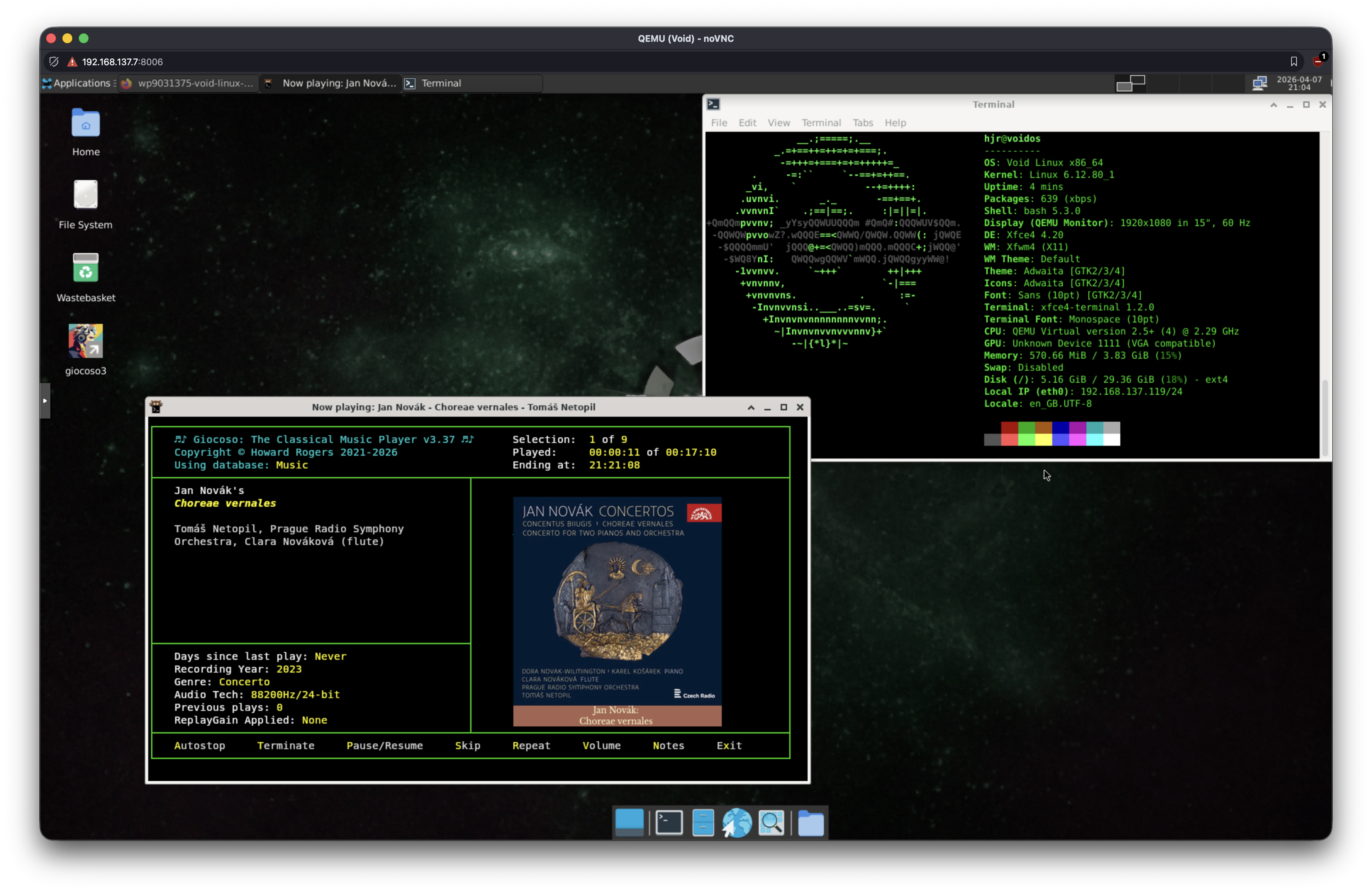
I don't know much about Void: it's a bespoke, rolling distro (meaning, it's unique and not based on Debian, Ubuntu, Fedora etc. etc. and is continually updated (though conservatively) rather than having six-monthly 'Big Bang' version increments). It has its own package management system (which resembles the one from Arch, but has its own unique command structure). And it happens to be able to run Giocoso flawlessly. It's also nicely minimal and if I was still doing Linux on a daily basis, I'd probably seriously look at it as my potential main distro. To me, it feels quite 'unix-y' or (more specifically) very 'BSD-y': and that's a good thing! One particular claim to fame, though it's perhaps likely to spark partisan controversy: it doesn't use systemd (it uses runit instead).
It is currently only 32nd on the list of distros at Distrowatch though, which would normally mean I wouldn't bother with it. But Dave Eddy uses it, and he's an absolute genius at Bash (in which Giocoso is written!) so, I wanted him to be able to use it without too much effort!
A couple of usage notes: you'll want to download the Giocoso installer script, but that requires the wget package, which isn't installed by default. I found I first needed to update the Void package installer itself:
sudo xbps-install -u xbps
After that, I was able to install the wget utility with the command:
sudo xbps-install -S wget
Once that's installed, you could try to run the Giocoso installer, but it will probably complain that your system needs to be updated, so make sure you do an initial:
sudo xbps-install -Su
…before trying to launch it. With those preliminaries out of the way, however, you simply do:
wget software.bbritten.com/gioinst
bash gioinst
…and you're away. Post-installation, you'll need to adjust things in the Administration menu, Option 2: I'd recommend altering the program logo size to 110 and its position to -4. After that, launch the Kitty terminal and type the command giocoso in that to get the full graphical effect:
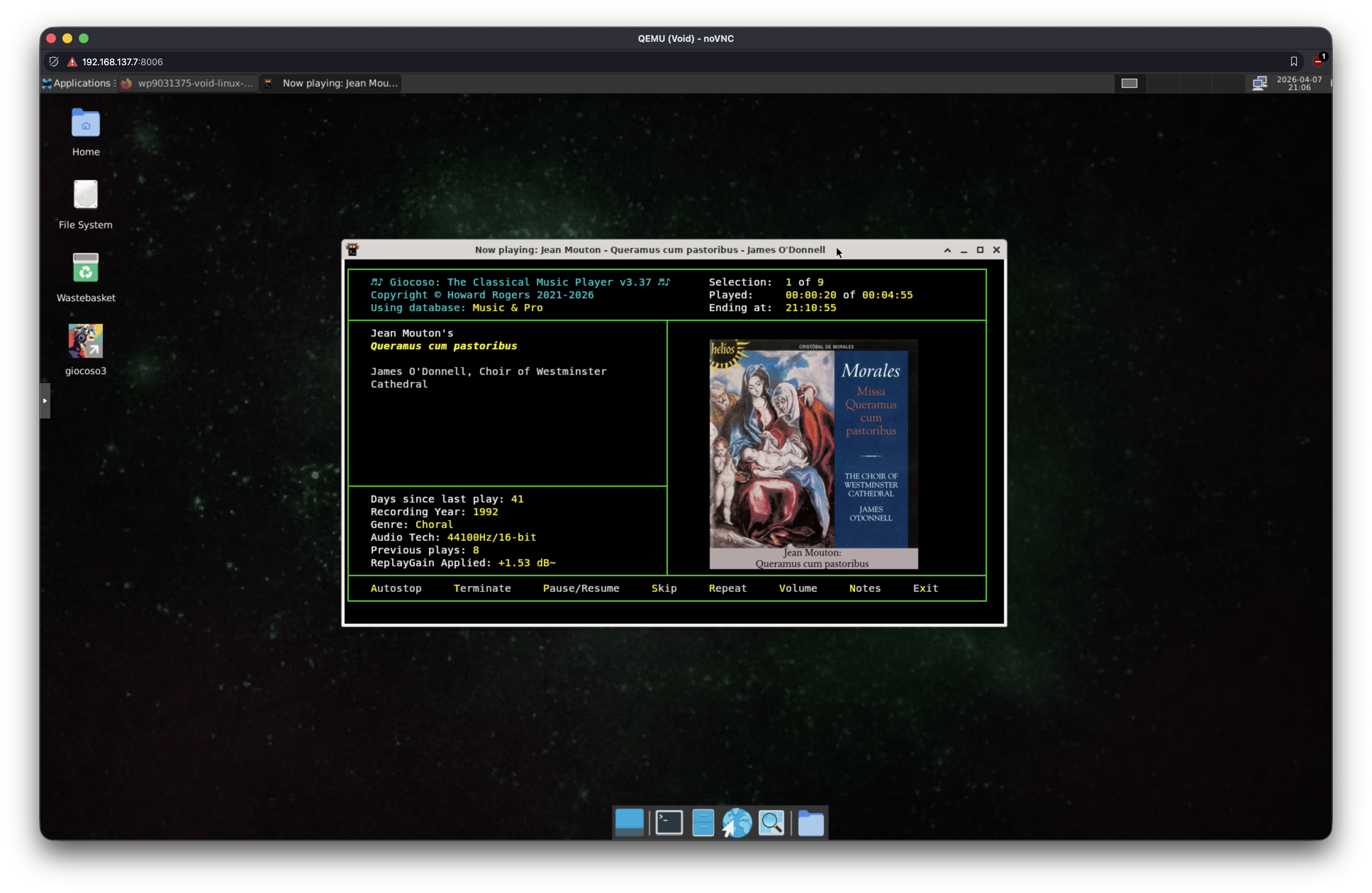
I say 'run Kitty' because Void's default terminal does not understand how to do sixel graphics or kitty graphics, so you'll need to use a terminal that does one or the other of them correctly to get the fully-intended 'out of the box' effect!
I should mention in passing that I have also removed support for Manjaro-on-Raspberry-Pi: I simply don't use it enough for it to be a viable, supported platform. Support for installing on 'Manjaro on Arm' disappears in the next Giocoso release, therefore (whenever that might be).
17000
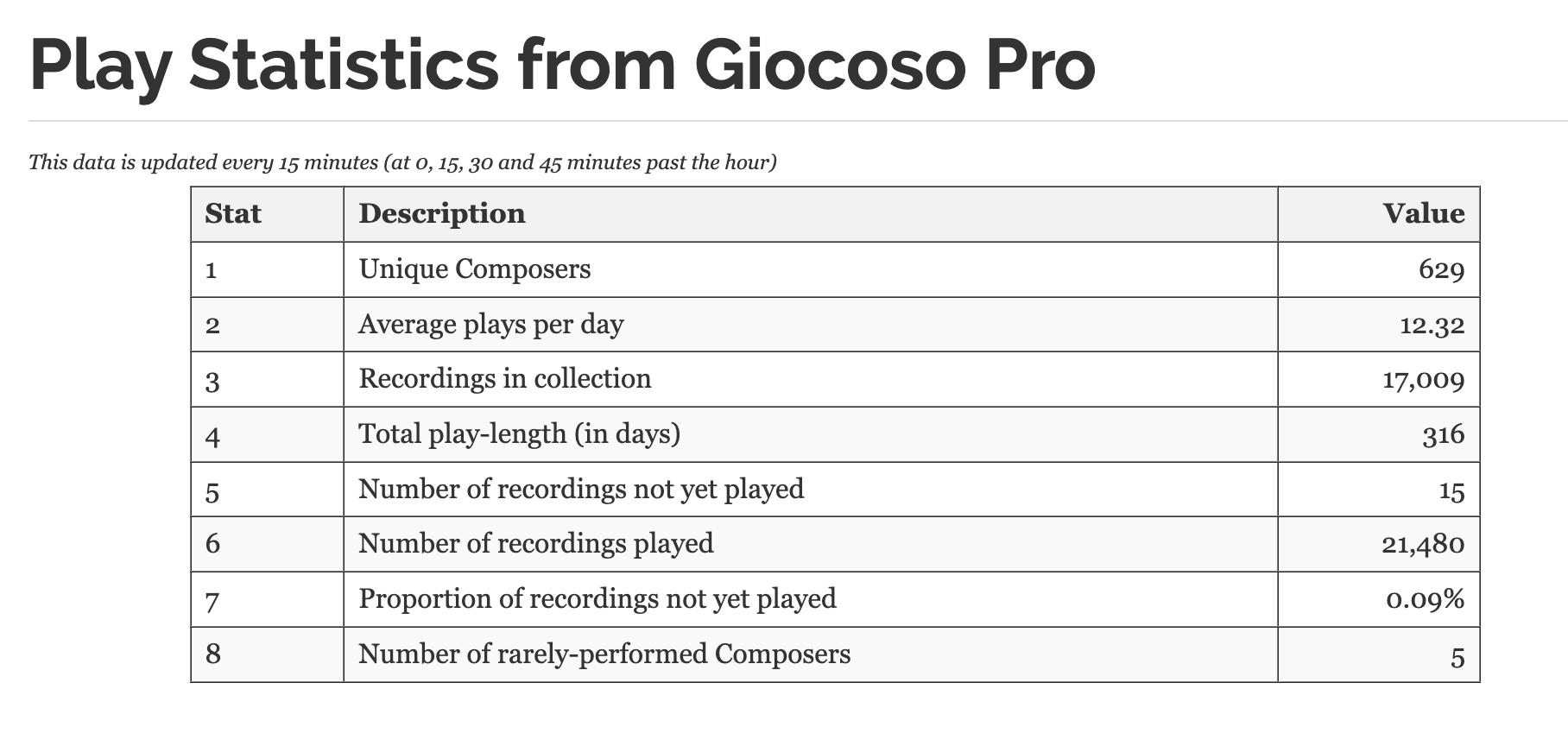 I couldn't let April 6th 2026 pass without mentioning that my music collection has finally, after quite a long time being lazy about cataloguing new additions, finally passed the “17,000 distinct recordings” mark, as shown in the statistics panel thumbnail at the left.
Rather more graphically:
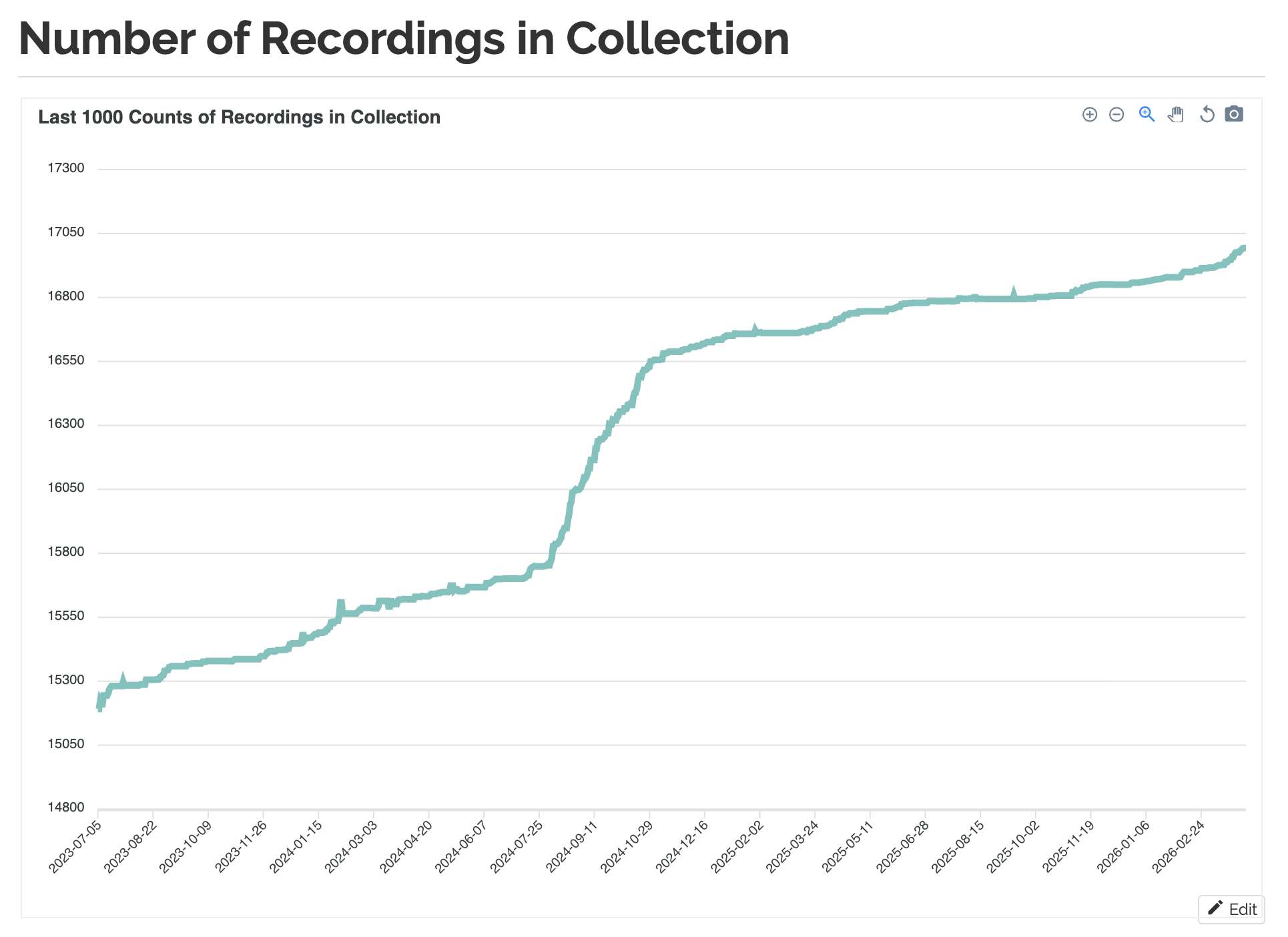
The recent upswing in the number of additions being made to the collection is a result of, at last, Semplice settling down on macOS. There's another 860GB of music which I've purchased in FLAC form, or in physical form and then ripped to FLAC, but which I've yet to tag properly and add to the collection: that process is just now getting seriously underway! I keep meaning to stop purchasing new music… but it's harder than it looks!
The addition which took things 'over the edge', past the 17,000 mark, was this one:

The Rubbra piano concerto was purchased back in about 2020, at the start of Covid, if I remember rightly: it's taken me this long to get round to 'processing' it! It was worth it, though I am now kicking myself for depriving myself of the works' pleasures all this time. It's an excellent piano concerto, recorded nicely and performed well. Recommended!
Giocoso Version 3.37 Released
 I have just released (on time!) a new version of Giocoso: it now moves to version 3.37. It is a fairly significant release for one main reason: the default music search algorithm had a fatal bug in it, which I discussed at length in a previous blog piece. This release fixes that logic error, resulting in much more music qualifying for randomised selection than before.
A less meaningful (but perhaps more fun!) enhancement to the program is that you can now adjust its visual components' colours. If you don't like the default cyan logo text, you can change it to magenta instead, for example. I noticed that some users don't run in jet-black terminal sessions like I do: this lets them make Giocoso usable even in light-coloured terminals.
I regret that this update is a bit messy to implement. You should certainly start by taking the usual Administration menu, Option 1 to obtain the newer software and providing the sudo password when prompted. Unfortunately, the result of that upgrade will look something like this:
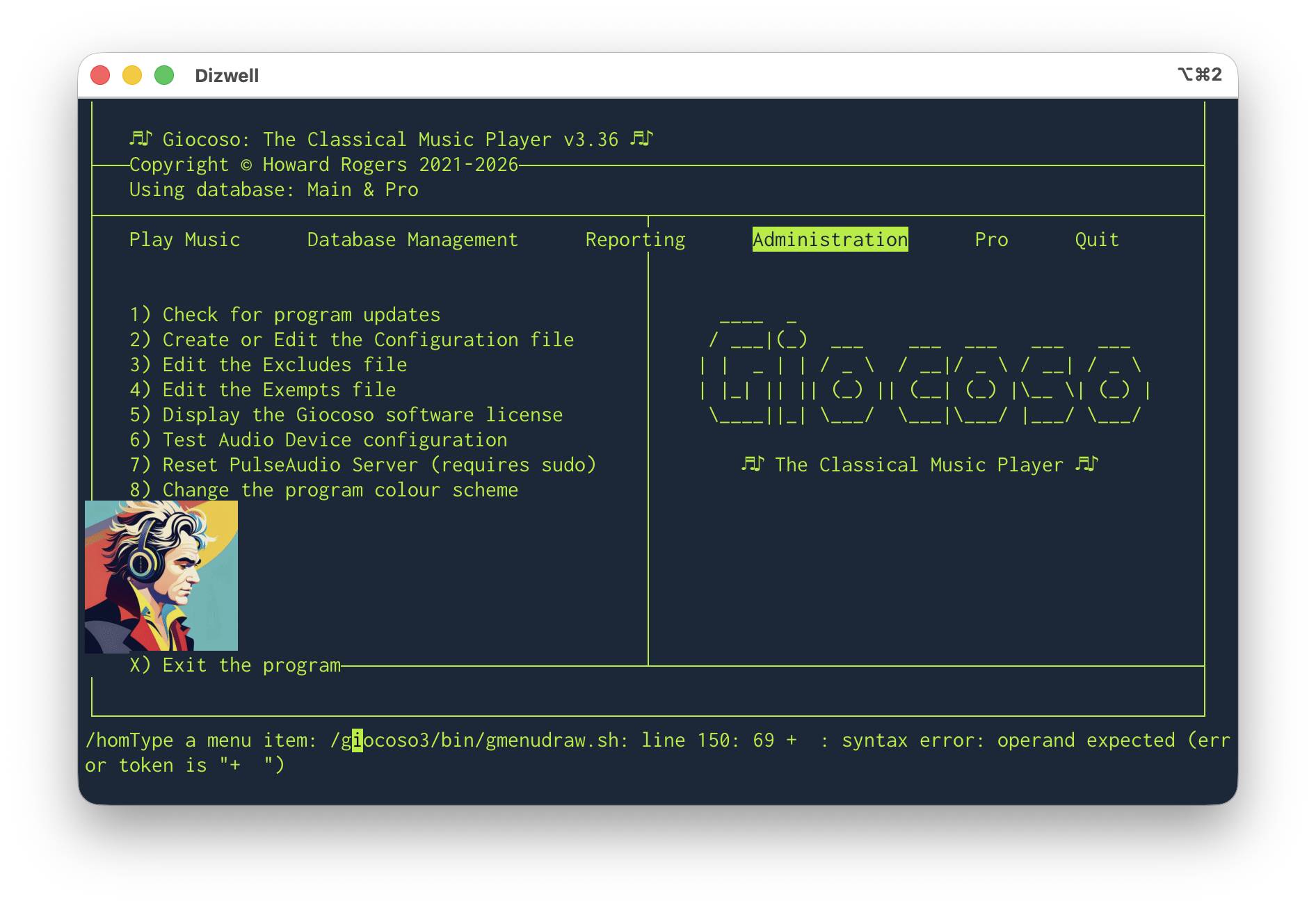
Error messages visible from the operating system, a Beethoven image appearing in completely the wrong place, all text one colour and the wrong colour at that… yuck! Fortunately, it's easily fixable: just take the Administration menu, Option 2 to edit the configuration file. Just click the [OK] button to cycle through all the pages of the dialog. When you click [OK] on the last of the pages, you'll be returned to the main menu with everything looking perfect:
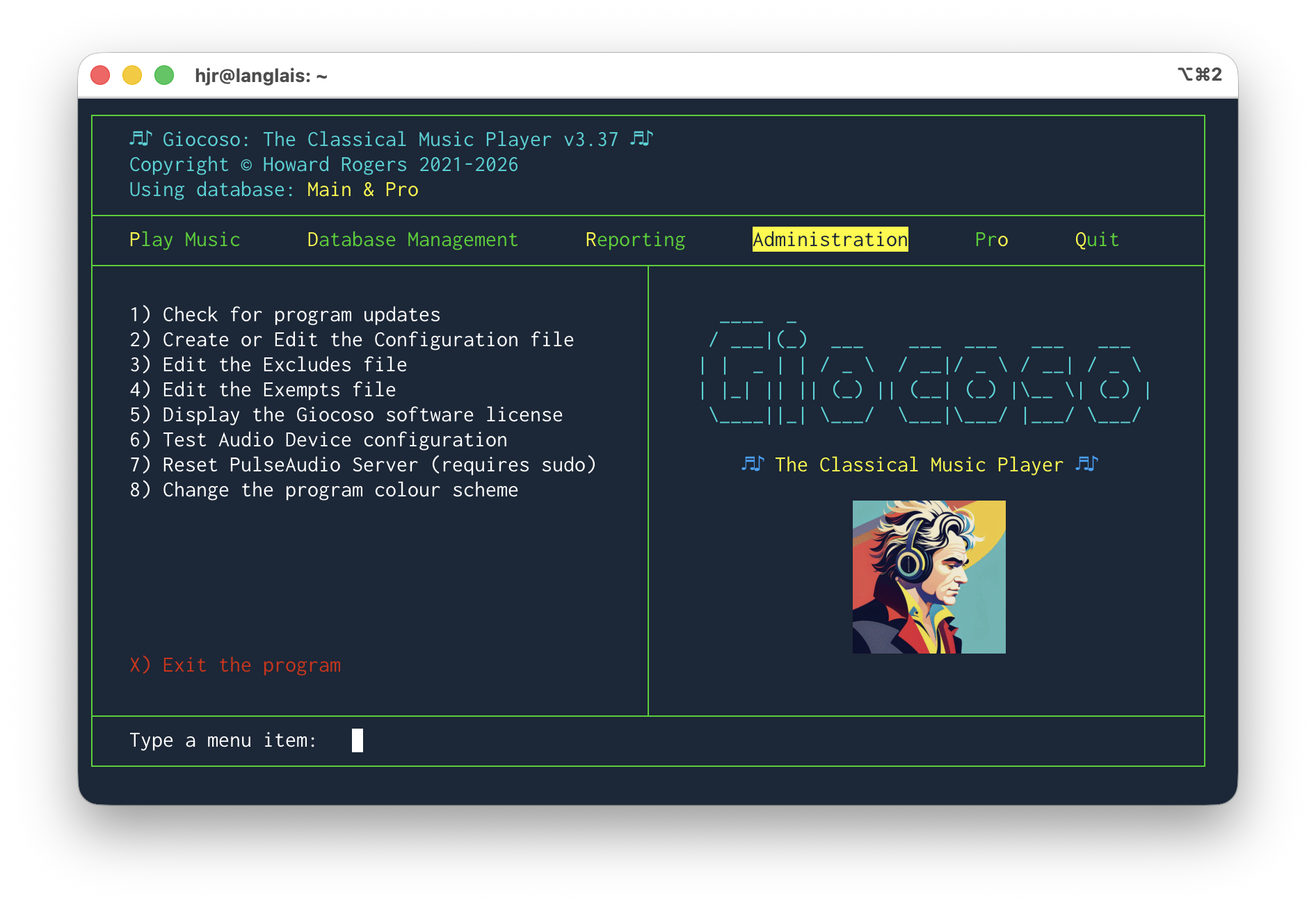
Added immediately after the release: It is possible that you now won't see visual mayhem on quite this scale after an update: a couple of tweaks to some code has tackled most of these issues out-of-the-box, I believe. But it does no harm to warn you of what can happen and how to fix it, especially as even now, I'm pretty sure you'll be needing to adjust the size of that Beethoven logo: which still requires a visit to the Administration menu, Option 2 and an adjustment to the 'Size of the Program Logo' setting.
The temporary problem is caused by your existing configuration file not having the new colour codes in it: merely editing the file and doing nothing causes default codes to be added to the file, after which the program displays normally. You could then use the new Administration menu, Option 8 to modify the program colour settings to something that is non-default and more suitable to your needs.
Full details about what's in the new release are available, as always, from the Giocoso changelog.
That concludes the bug-fixes and tweaks to all three of my music-related bits of software: I rather suspect that they will all now 'go quiet' for a good few month, unless someone gets in touch to report a bug or two that I haven't encountered! Here's to a less code-filled few months!
Semplice Version 2.13 Released
 A little later than intended, but I've just released the new Version 2.13 of Semplice. It's quite a substantial release: the new graphical look and feel is perhaps the most obvious one, along with the ability to set the colours for the individual display elements of the program interface. Under the hood, some fairly significant bugs got squashed, too, however: the biggest ones are mostly to do with making Semplice a first-class citizen on a macOS installation. In particular, macOS's handling of Unicode characters that involve accents is, er… “unpredictable” and the new version of Semplice brings some order to the chaos! Full details, as always, are available from the Semplice Changelog.
This update is, unfortunately a 'breaking update', meaning that simply taking the Administration menu, Option 3 will certainly upgrade to the latest Semplice release, but it will look like a disaster when you're done and some important things will be missing (which won't be missing if you were doing a fresh install, by the way).
So, to ensure the unpleasantness is kept to a minimum, you need to do a bit more than just taking that 'check for program updates' menu option. The first thing you need to do (again, only if you're upgrading an existing Semplice installation) is to install some extra packages which are new dependencies that Semplice now has and didn't before:
- Fedora: sudo dnf install libsixel libsixel-utils kitty
- Mint: sudo apt install libsixel-bin kitty
- AlmaLinux10: sudo dnf install kitty
- Suse: sudo zypper install libsixel1 libsixel-utils kitty
- Arch: sudo pacman -S kitty libsixel
- Debian/Raspbian: sudo apt install libsixel-bin kitty
- Ubuntu: sudo apt install libsixel-bin kitty
Once that new software is installed, you can proceed to do the standard Semplice upgrade procedure (i.e., take the Administration menu, Option 3 and supply the sudo password when prompted). The upgrade will appear to fail:
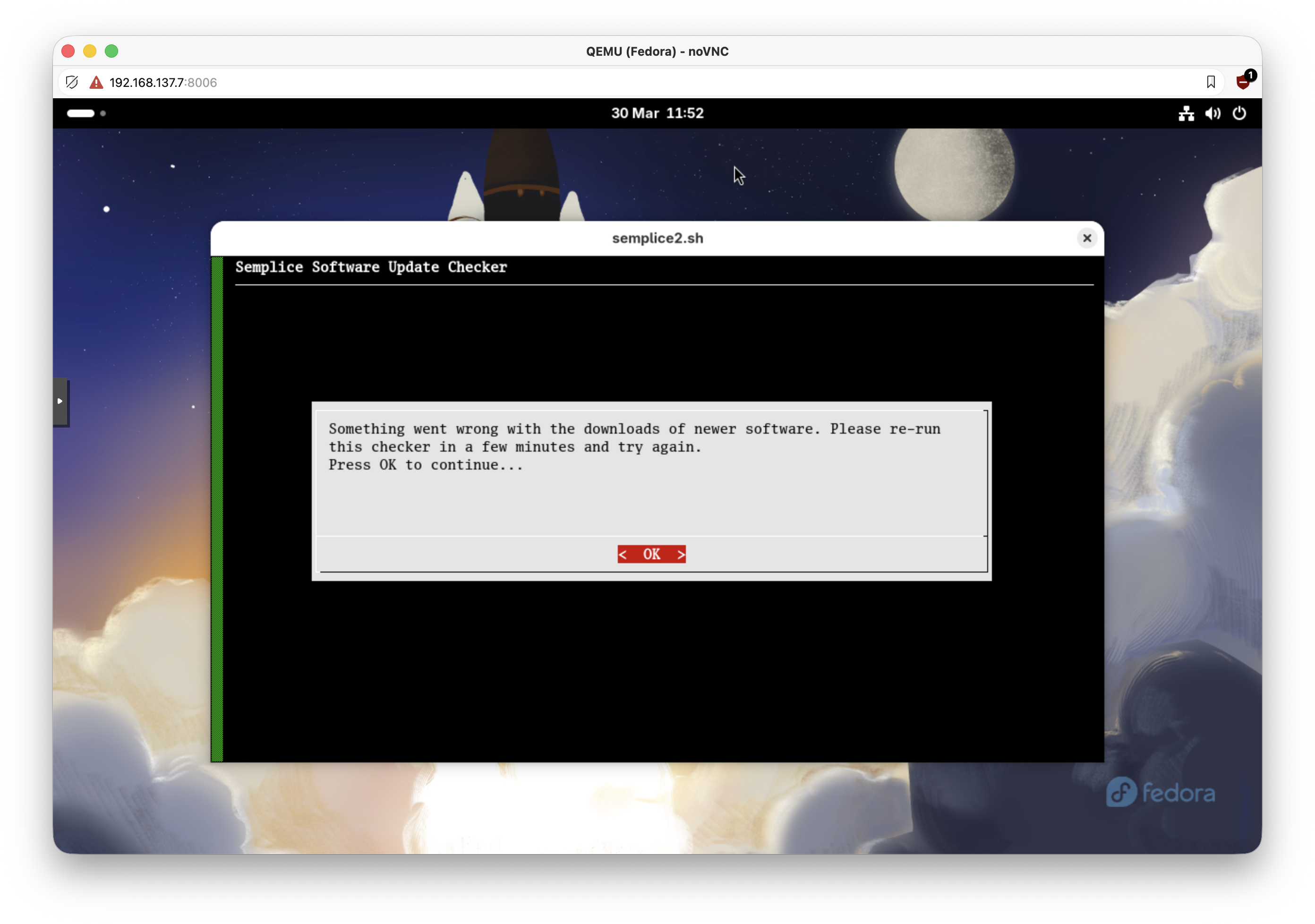
Don't worry about that: just press [Enter] or click OK to accept the message: you'll be returned to the main program screen, which will look ghastly:
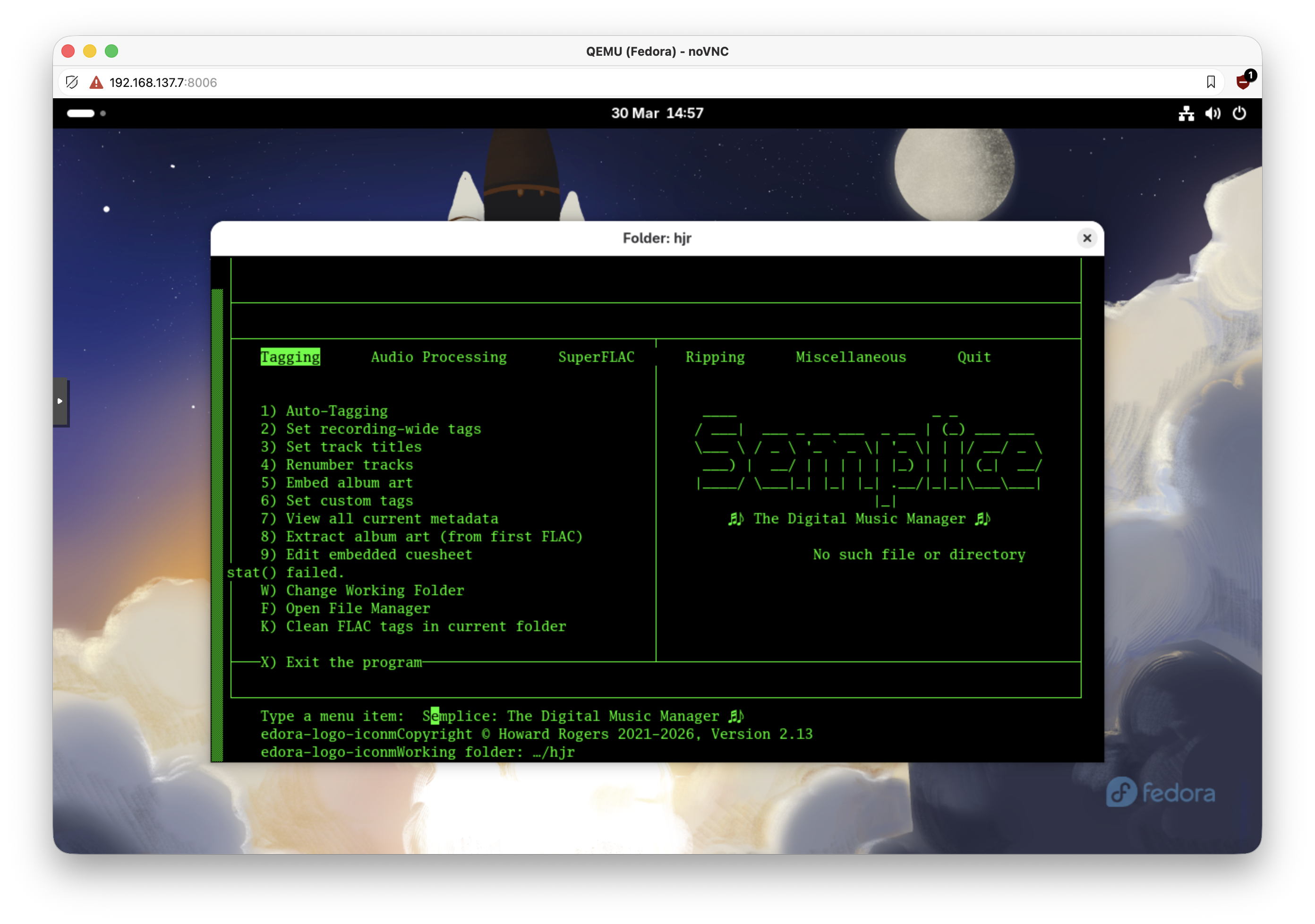
Don't worry about this, either. Just take the Miscellaneous menu option once more, Option 1 to edit the configuration file and then keep pressing [Enter] to step through every page of options without changing anything. When you press [Enter] on the last page of the configuration options, you'll return to the main program menu and see this:
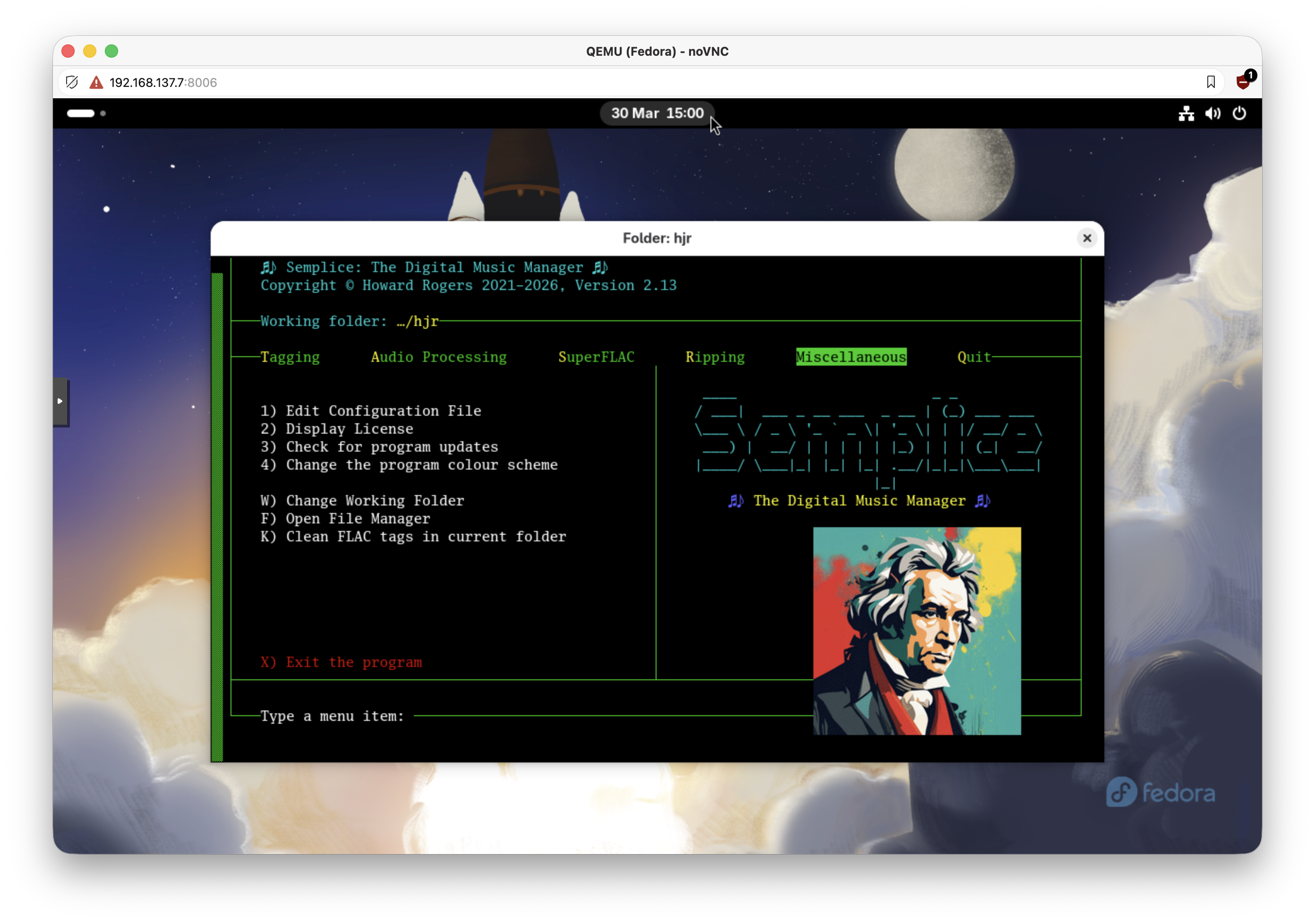
At this point, the only real problem remaining is the size of the 'grumpy Beethoven' logo, over on the right of the program display: go back into the Edit Configuration File option once more. On the last page, you'll find a set of four new configuration options:
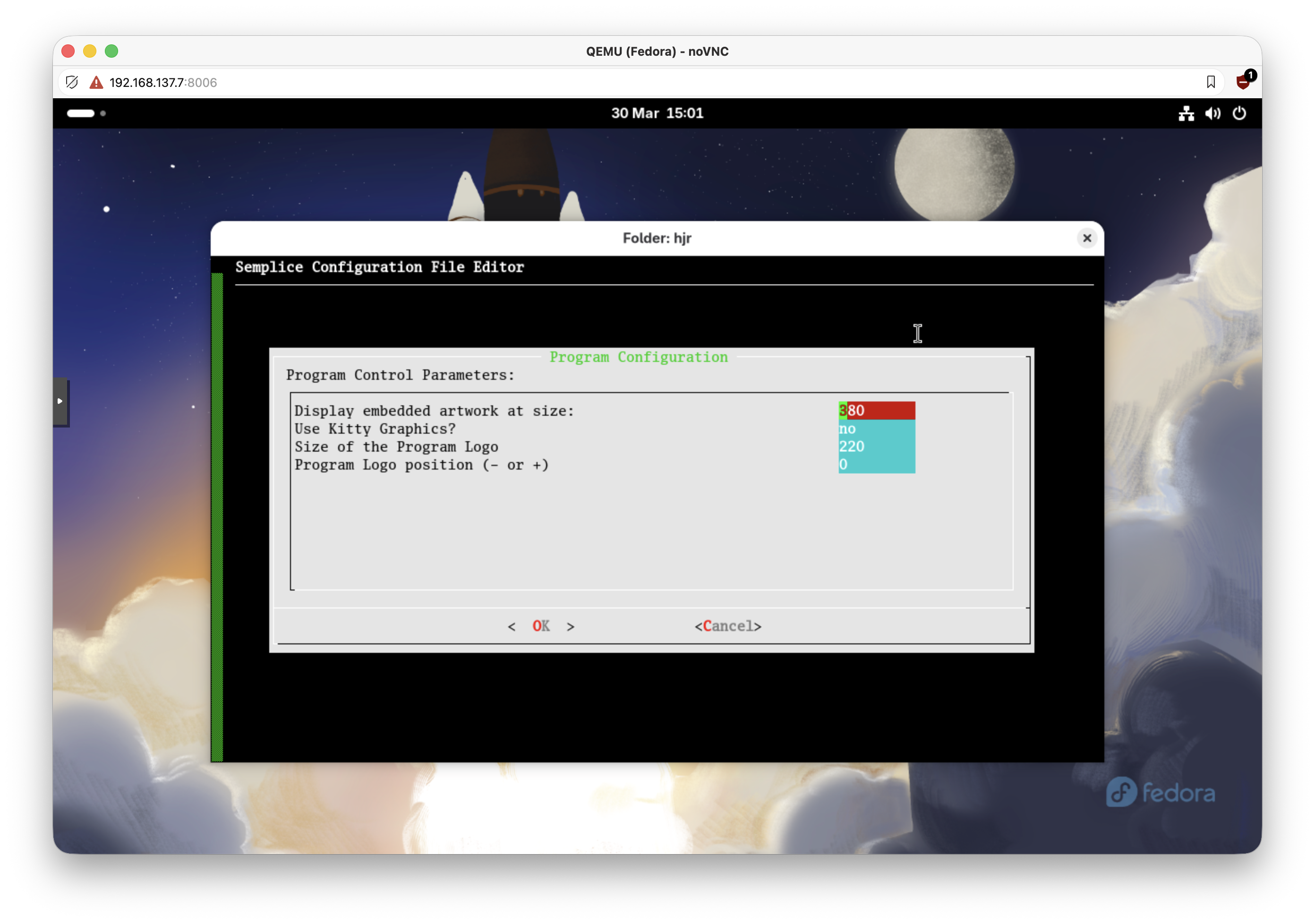
Set the “size of the program logo” to something smaller or larger, depending on how things are appearing on your screen. Use the “program logo position” parameter to supply a negative (move left) or positive (move right) number to adjust the precise position of the logo. For my Fedora installation, I found a size of 110 and a position of 0 worked fine, but your mileage might vary:
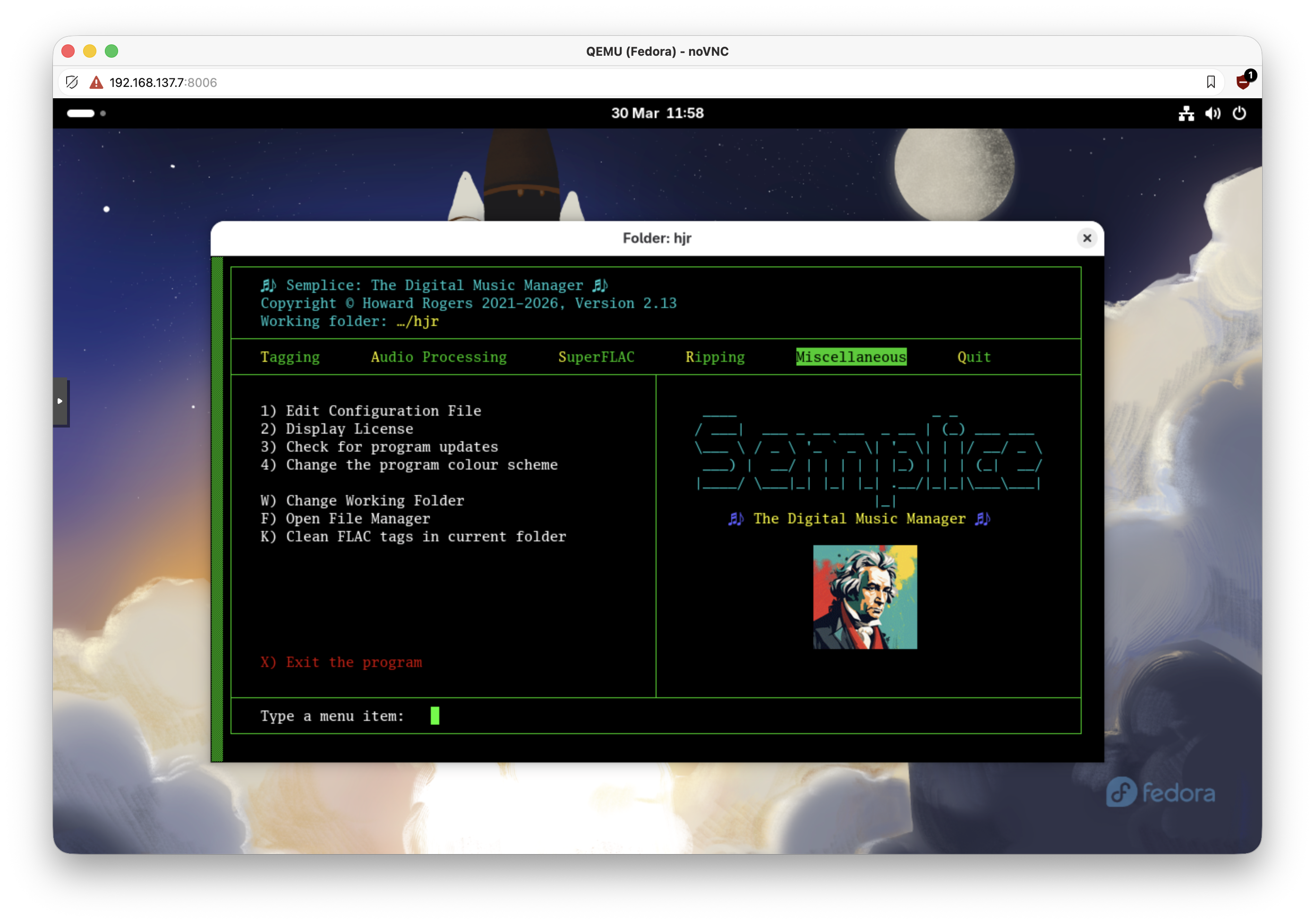
Once the display looks fine, your upgrade is complete. I apologise for the fact that this upgrade is non-trivial and requires a bit of manual intervention on your part beforehand: I try to keep these 'breaking updates' to a minimum and I hope this will be the last one for a good long while!
Finally, note that on AlmaLinux, the terminal type that the Semplice launcher runs Semplice in cannot display graphics: that's why these instructions mentioned installing the Kitty terminal, which can display those graphics (this may be true for other distros, too). It is accordingly recommended that you use the Kitty terminal for all Semplice operations on that platform in future. If you want to adjust the program launcher so that it invokes Kitty automatically, you'll need to edit the appropriate launcher file. That's located in $HOME/.local/share/applications/semplice.desktop. So:
nano $HOME/.local/share/applications/semplice.desktop
Change the “Exec” line of the file. At the moment, it's reading something like:
Exec=/usr/bin/xterm -xrm 'xterm*iconHint: /home/hjr/.local/share/semplice2/art/sempliceico.xpm' -bg black -fg green -geometry 103x28 -fa 'Luxi Mono:style=Regular' -fs 11 -ti 340 -tn xterm-256color -e semplice2.sh
Change that to read (rather more simply!):
Exec=/usr/bin/kitty -e semplice2.sh
You may also want to configure Kitty generally to display things in a nicer fashion than it does by default. That's done by editing the $HOME/.config/kitty/kitty.conf file. My own is very, very simple:
font_family      family='Luxi Mono' postscript_name=LuxiMono
font_size 12.0
…but many more configuration options are available to anyone with time to invest in such things!
Niente Version 5.05 Released
 I have just released (almost on-time!) the latest version of Niente: version 5.05. The changelog, as ever, has all the details, but the short version is that there was a fairly nasty bug concerning Niente and ReplayGain, which is now fixed; and there's been a whole truck-load of flim-flammery concerning Niente's visual appearance. The story there is, basically, to bring it in-line with how all my other software works (or is about to work): colour selection and a graphical logo.
Unfortunately, these changes mean that the upgrade process is not as simple as using the Administration menu, Option 5. It's a little bit more convoluted than that! Here goes:
First, make a note of all your existing configuration settings. We're going to wipe these shortly and you'll need to be able to put them back later. So take a screenshot now of Administration menu, Option 5 and or otherwise note the contents of that configuration setting: we're going to need to use that as a template later.
Next, you need to ensure that both libsixel and kitty are installed, so that Niente can do its new 'graphical logo thing'. How you do that depends on your distro:
- Fedora: sudo dnf install libsixel libsixel-utils kitty
- Mint: sudo apt install libsixel-bin kitty
- AlmaLinux10: sudo dnf install kitty
- Suse: sudo zypper install libsixel1 libsixel-utils kitty
- Arch: sudo pacman -S kitty libsixel
- Debian/Raspbian: sudo apt install libsixel-bin kitty
- Ubuntu: sudo apt install libsixel-bin kitty
I should explain that I cannot find a way to install sixel graphics support on AlmaLinux 9 or 10, so we don't bother and instead install the Kitty terminal, which is a completely different ball-game that still manages to install support for doing in-terminal graphics. Note that this means either that 1) you can't use 'gnome terminal“ to run Niente going forward; or 2) if you insist on using gnome-terminal, you're not going to see the 'beethoven looking grumpy' logo.
Anyway, once those new packages are installed, you fire up Niente and take the Administration menu, Option 5: Check for software updates. Follow the prompts and the upgrade process should complete without error… except that you're very likely to see variations on this unholy mess at the end of it:
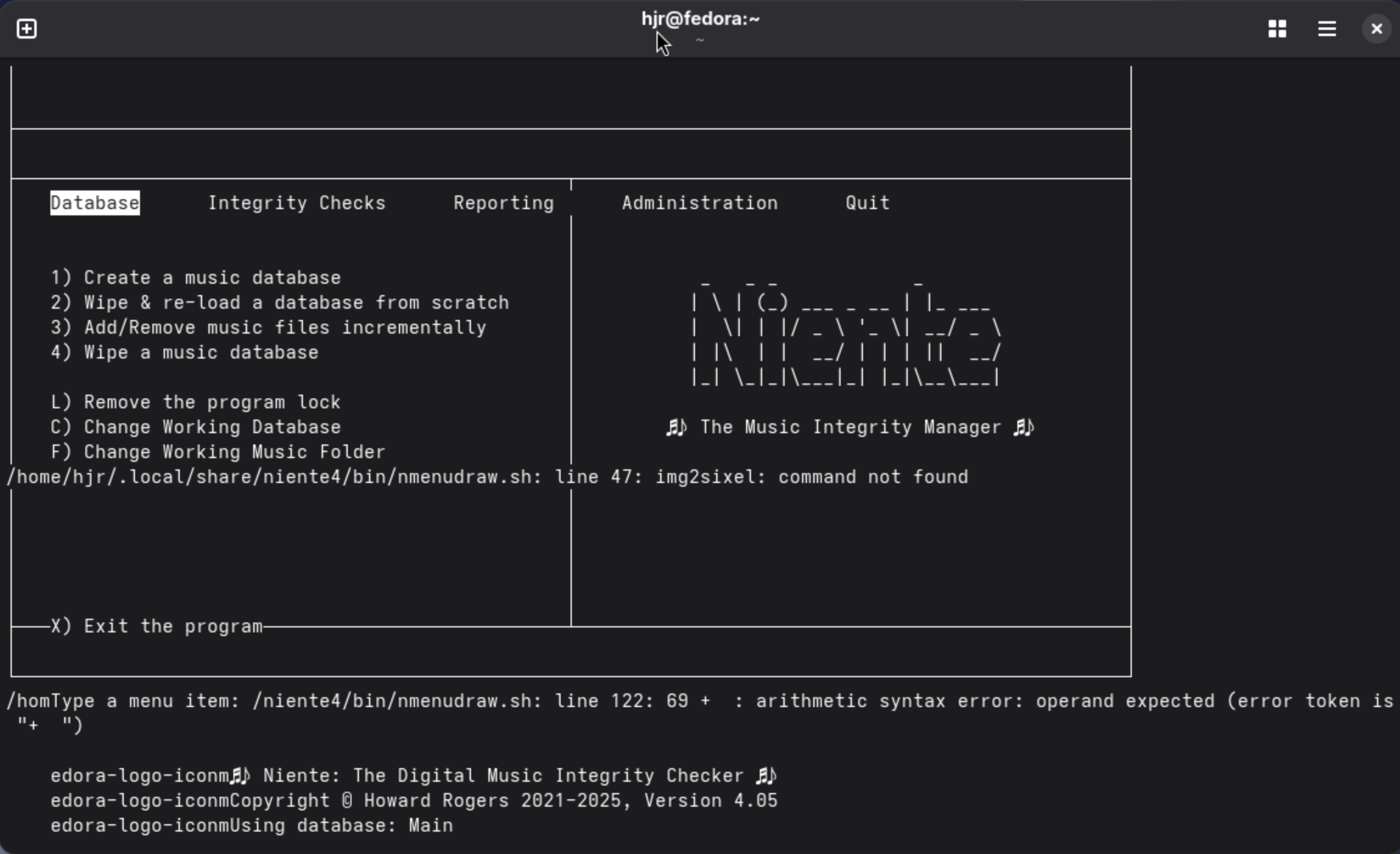
Don't panic! At this point, exit Niente (tap 'x') and then issue this command:
rm -f $HOME/.local/share/niente/txt/niente.conf
That deletes your specific persistent configuration file, because the absence of such a file triggers Niente to create a default one, containing all the new parameters that the new version expects to find. Of course, this also means that the new configuration file will be missing all the really important personalised settings you may have set previously: that's why you were told to make a note or screenshot of those existing settings before we started! You did do that, didn't you?!
Now you can re-launch Niente (on AlmaLinux, this must be from within Kitty): you will likely be warned that your new, default configuration file mentions a database called “niente” (the default name), but that no such database exists:
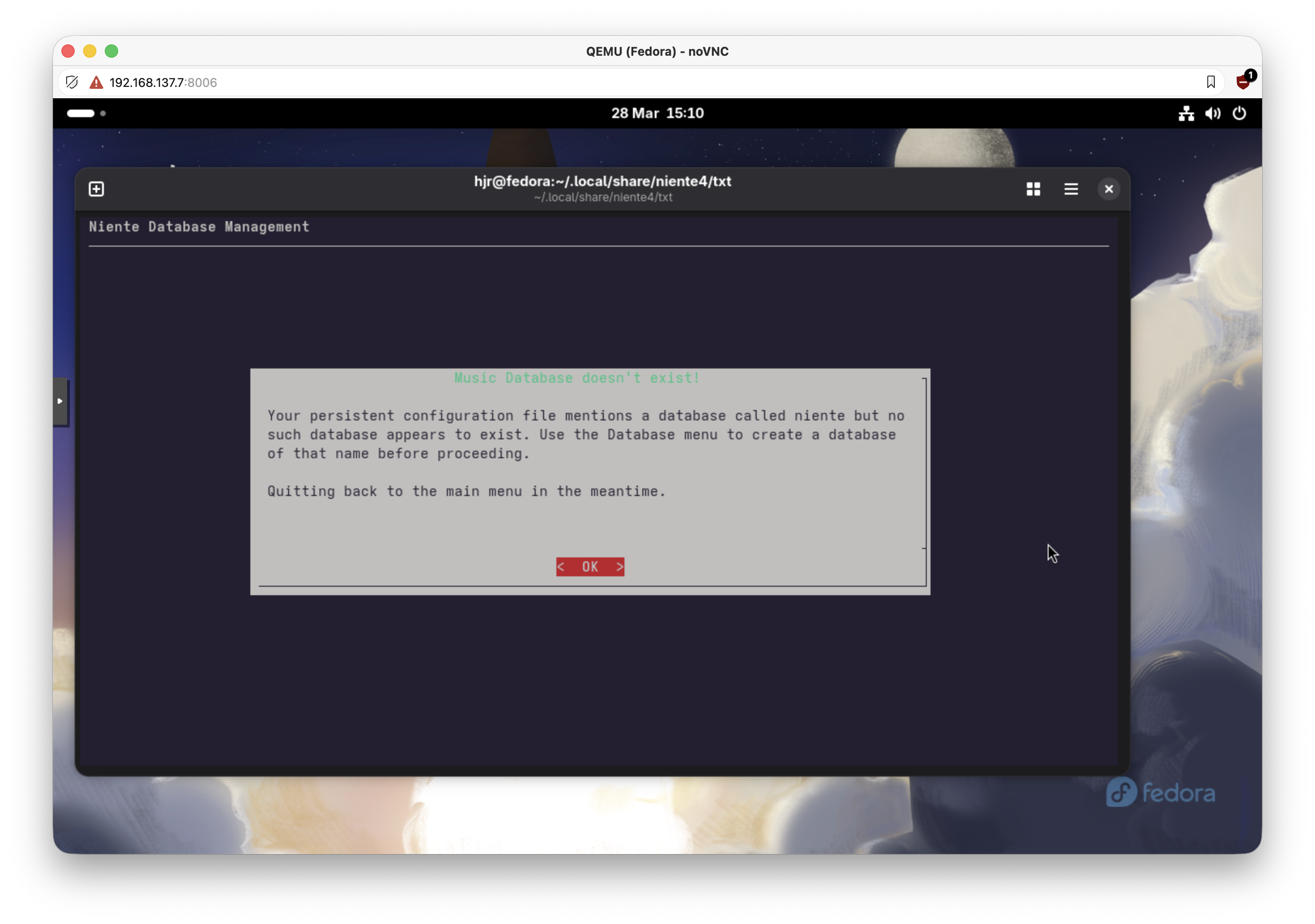
Again, this is the consequence of having deleted your original configuration file. It's expected, so click [OK] and Niente will launch in its new 4.05 guise. Immediately visit the Administration menu and take the Edit Configuration File option. Put back all the 'correct' configuration file options you previously made a note of, such as the default database name. Make sure you add in values for 'Preferred browser', for example. If you are on AlmaLinux, you must switch on “Use Kitty Graphics”: set it to a value of “yes”. Quit Niente once more and then immediately relaunch into it: you should now find that you're viewing Niente correctly, with colour, and with a colourful logo in the left-hand pane:
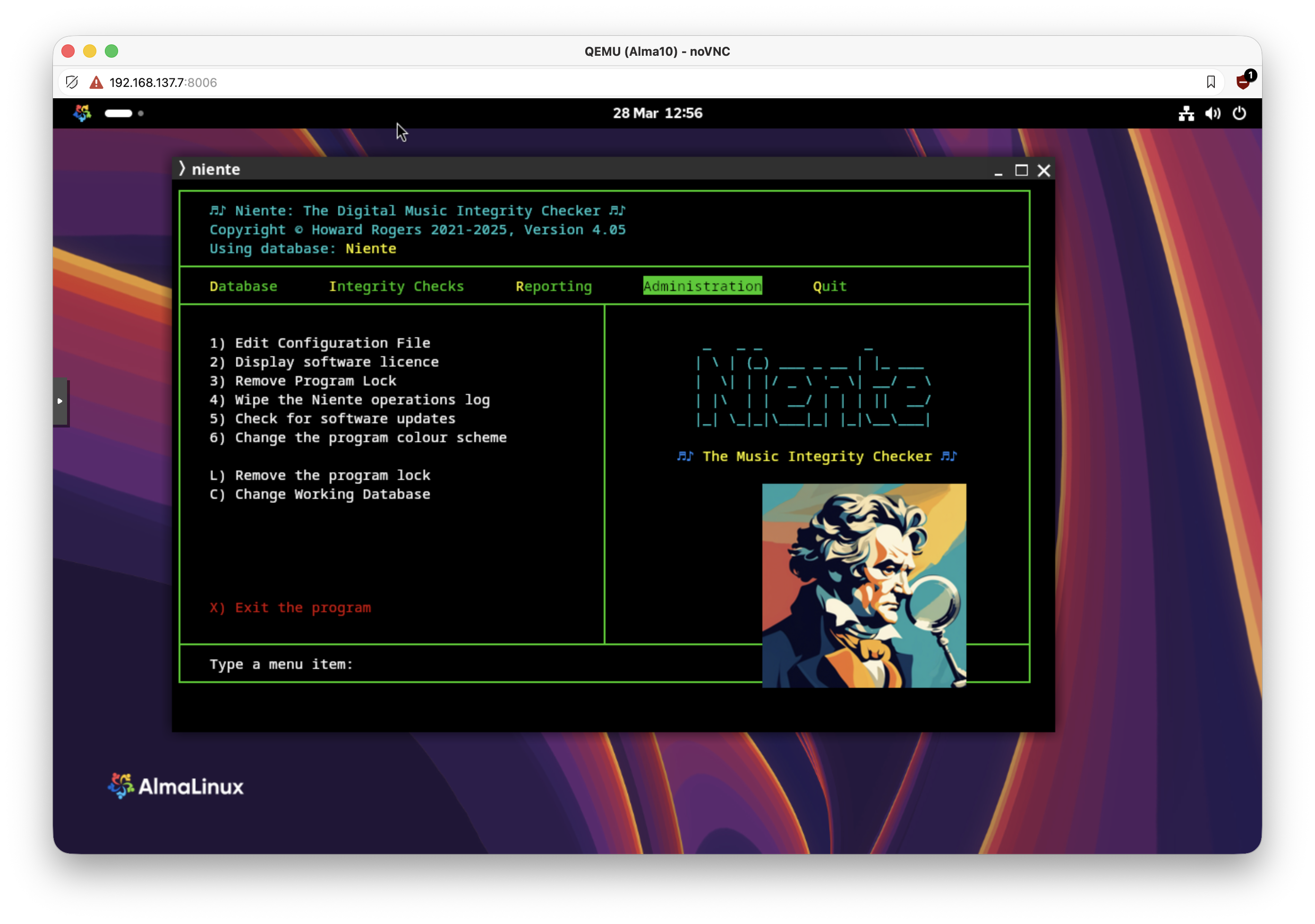
You may well notice, as in this screenshot, that the logo is way too big and in completely the wrong place! Again, don't panic: you have the Administration menu, Option 1 to adjust the 'Size of the Program Logo' and the “Program Logo position'. On my particular virtual machine, displaying on an iMac (so who knows what the right settings might be on real hardware?!), I found setting the logo size to “110” and the position to ”-5” to be ideal:
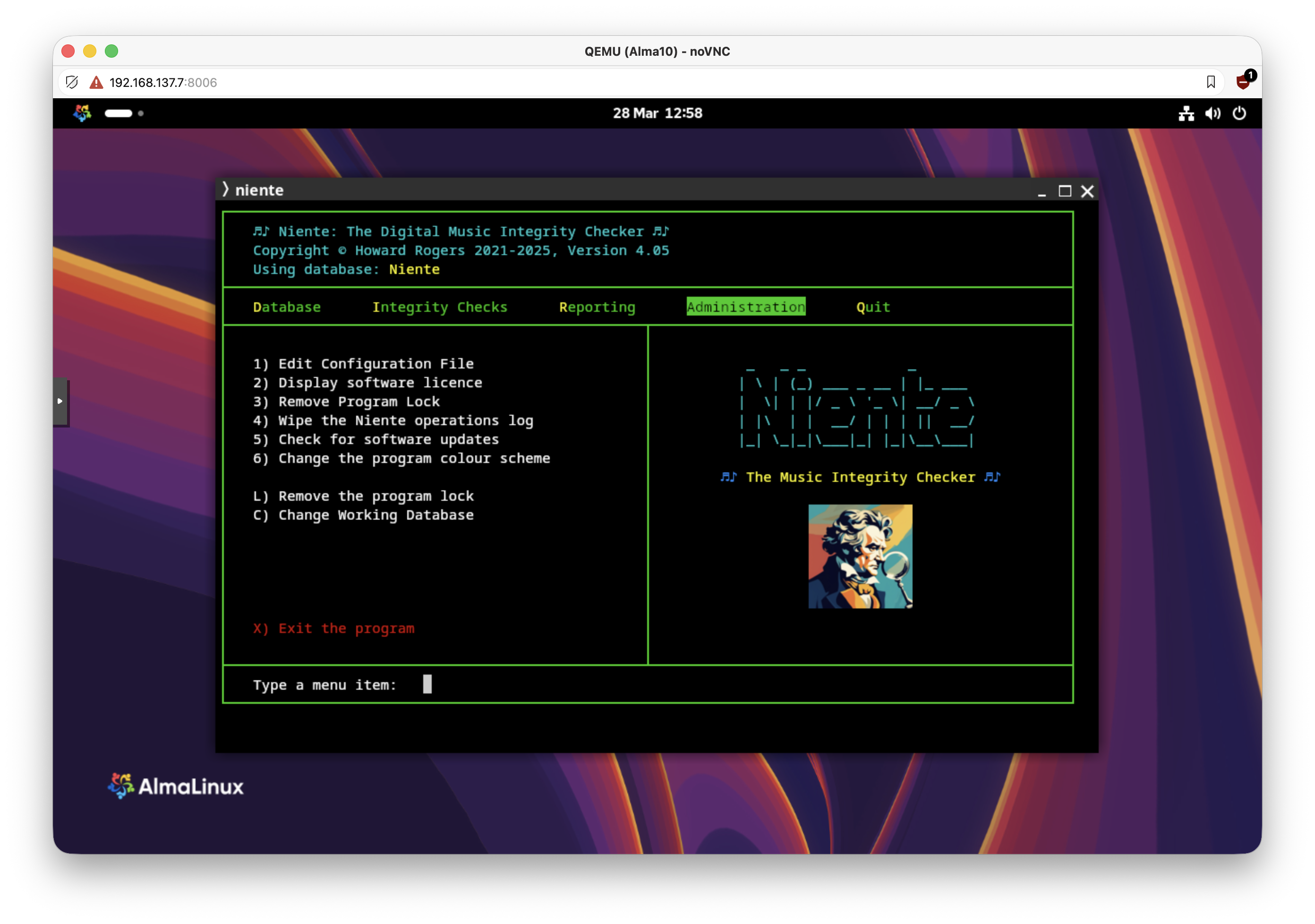
Play around as you like… and then consider taking the Administration menu, Option 6 to fiddle with the colour values associated with the various program display elements.
I'm sorry the upgrade process is a bit more convoluted than normal this time around. If you prefer, you can simply re-install Niente from scratch:
wget software.bbritten.com/neninst
bash neninst
A fresh install automatically installs the Kitty terminal and libsixel components needed to get that graphical logo displayed correctly. For a mere upgrade, you have to take care of those extra component requirements manually, I'm afraid. It is a once-off requirement! I did find that even on fresh installations, Niente would look ghastly until you had taken the Administration menu, Option 1 and pressed [Enter] to create a new persistent configuration file: it's a quirk of the transition, sadly.
Additionally, note that you don't have to run Niente with a graphical logo. If you would prefer to run Niente on AlmaLinux (for example) in the gnome-terminal, without switching on Kitty graphics, that will work just fine:
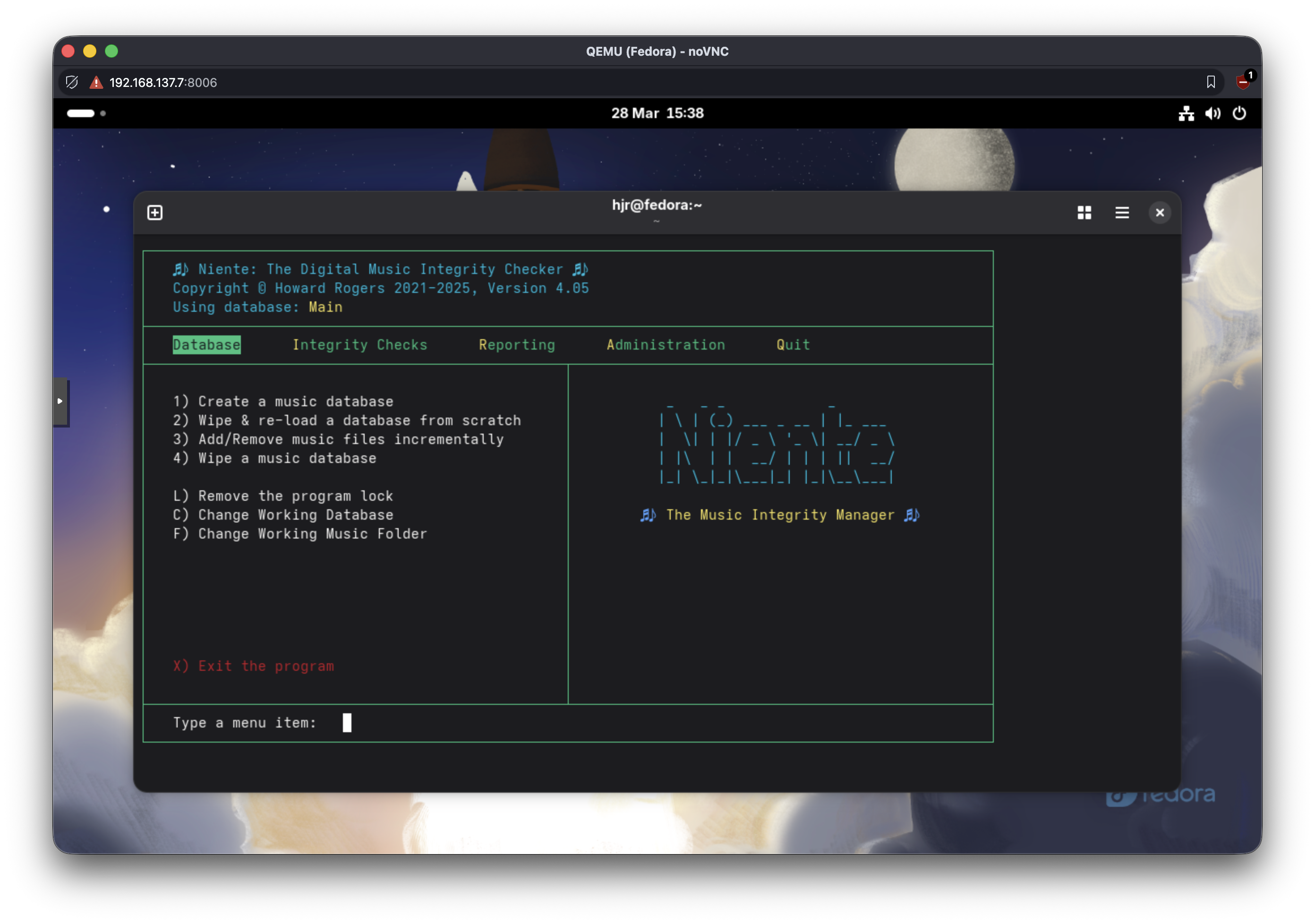
You just won't see the 'grumpy beethoven' icon on the right-hand side (which some might prefer, the Luddites!)
Note that unmentioned in the changelog is a bunch of code tidying that is really rather important that you have: I can't tell you the number of subtle code howlers I spotted whilst preparing this release! So I'd encourage you to upgrade, apologise again for the extra steps required, and assure you that nothing this big should happen again for quite a long time!